
Fusing vision, speech and gaze#
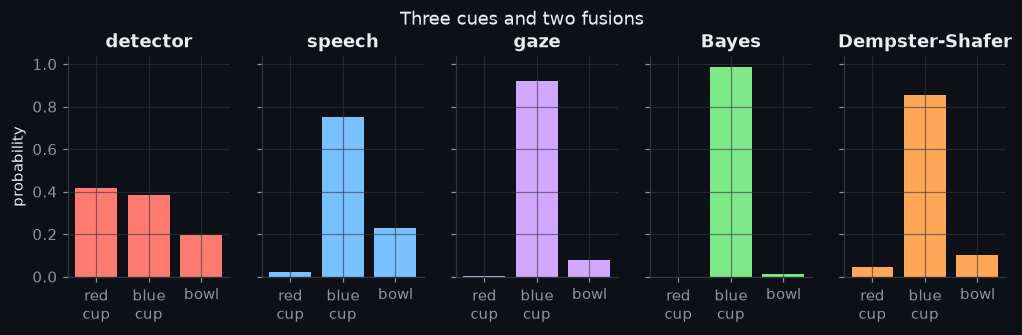
The person says “the blue one” and looks to the right; the detector sees a red cup, a blue cup and a bowl with different scores. Each source gives evidence about which object is meant. This tutorial turns each source into a likelihood with an adapter, then fuses them three ways: Bayesian (multiply), Dempster-Shafer (combine belief masses, with explicit ignorance) and quantum-like (each cue is a basis in a shared space, so cues can be incompatible and the order they are considered matters). The three are compared on held-out simulated trials.
import numpy as np
import matplotlib.pyplot as plt
from quantum_mind.viz import use_mpl_style
from quantum_mind.applications.fusion import (detector_likelihood, asr_likelihood, direction_likelihood,
                                              bayes_fusion, dempster_shafer_fusion, fit_incompatibility, compare_fusion)
from quantum_mind.applications.intent import QuantumIntentResolver
theme = use_mpl_style('dark')
objects = ['red cup', 'blue cup', 'bowl']
1. Adapters: from raw outputs to likelihoods#
det = detector_likelihood({'red cup': 0.62, 'blue cup': 0.55, 'bowl': 0.20}, objects, temperature=1.5)
asr = asr_likelihood([('the blue one', 0.7), ('the bowl one', 0.2)],
                     {'red cup': ['red'], 'blue cup': ['blue'], 'bowl': ['bowl']}, objects)
gaze = direction_likelihood([0.9, 0.3], {'red cup': [-1, 0], 'blue cup': [1, 0.2], 'bowl': [0.2, 1]}, objects)
cues = {'detector': det, 'speech': asr, 'gaze': gaze}
for k, v in cues.items():
    print('%-9s %s' % (k, v.round(3)))
detector  [0.418 0.386 0.197]
speech    [0.021 0.75  0.229]
gaze      [0.001 0.921 0.078]
2. Fuse#
bayes = bayes_fusion(list(cues.values()))
ds, ignorance = dempster_shafer_fusion(list(cues.values()), reliabilities=[0.8, 0.9, 0.6])
print('Bayes            ', bayes.round(3))
print('Dempster-Shafer  ', ds.round(3), '  ignorance %.3f' % ignorance)
Bayes             [0.    0.987 0.013]
Dempster-Shafer   [0.046 0.853 0.1  ]   ignorance 0.018
fig, axes = plt.subplots(1, 5, figsize=(11, 2.6), sharey=True)
panels = list(cues.items()) + [('Bayes', bayes), ('Dempster-Shafer', ds)]
for ax, (name, v), c in zip(axes, panels, theme['palette'] + theme['palette']):
    ax.bar(range(3), v, color=c); ax.set_title(name); ax.set_xticks(range(3), ['red\ncup', 'blue\ncup', 'bowl'])
axes[0].set_ylabel('probability'); fig.suptitle('Three cues and two fusions', y=1.04)
plt.show()
3. Learn how incompatible the cues are, and compare on held-out trials#
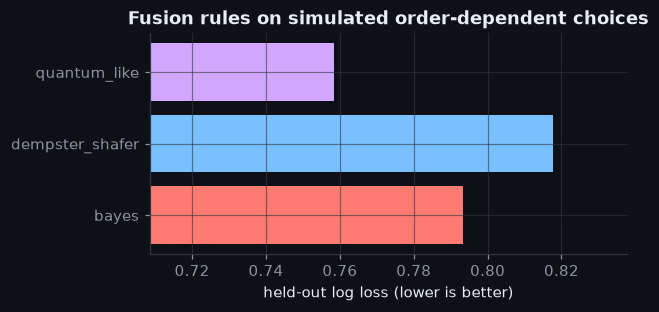
Simulate people whose choices follow a quantum-like resolver with two cues of known incompatibility, in both cue orders. Fit the incompatibility angles on 1000 trials, then compare log loss on 500 new ones (lower is better).
intents = ['a', 'b', 'c']
cue_l = {'x': [0.7, 0.2, 0.1], 'y': [0.25, 0.6, 0.15]}
truth = QuantumIntentResolver(intents)
truth.add_cue('x', cue_l['x'], 0.7)
truth.add_cue('y', cue_l['y'], 0.7)
rng = np.random.default_rng(1)
orders = [['x', 'y'], ['y', 'x']]
trials = [(o, intents[rng.choice(3, p=truth.posterior(o))]) for o in [orders[i % 2] for i in range(1500)]]
_, angles = fit_incompatibility(QuantumIntentResolver, intents, cue_l, trials[:1000])
print('fitted angles:', {k: round(v, 2) for k, v in angles.items()}, '(true 0.7 each)')
res = compare_fusion(intents, cue_l, trials[:1000], trials[1000:])
res = {k: v for k, v in res.items() if isinstance(v, dict) and 'log_loss' in v}
for k, v in res.items():
    print('%-16s held-out log loss %.3f' % (k, v['log_loss']))
fitted angles: {'x': 0.74, 'y': 0.8} (true 0.7 each)
bayes            held-out log loss 0.793
dempster_shafer  held-out log loss 0.818
quantum_like     held-out log loss 0.759
fig, ax = plt.subplots(figsize=(5.6, 2.6))
names = list(res); vals = [res[k]['log_loss'] for k in names]
ax.barh(names, vals, color=theme['palette'][:len(names)])
ax.set_xlim(min(vals) - 0.05, max(vals) + 0.02); ax.set_xlabel('held-out log loss (lower is better)')
ax.set_title('Fusion rules on simulated order-dependent choices')
plt.show()
The statements below are checked by this cell every time the documentation is built:
assert res['quantum_like']['log_loss'] < res['bayes']['log_loss']
print('checked')
checked
Caveat. These people are simulated from the quantum-like resolver, so it is expected to win; the point is the workflow. The angles are only weakly identifiable from choices alone, so report them with uncertainty.
References: Ernst & Banks (2002), Nature 415, 429-433; Shafer (1976), A Mathematical Theory of Evidence; Busemeyer & Bruza (2024), ch. 4.