
When should a robot ask for help?#
A robot is asked to fetch “the red cup on the left”. It has a hypothesis, but it is not sure. It can act now and risk a wrong action, or ask a clarifying question and spend the person’s time. This tutorial builds the decision rule step by step: the expected cost of each choice, the robot’s uncertainty about its own models of people, and the hazard of the action.
import numpy as np
import matplotlib.pyplot as plt
from quantum_mind.viz import use_mpl_style
from quantum_mind.applications.robotics import (domain_models, HumanModelEnsemble, ask_or_act,
                                                risk_aware_ask_or_act, HAZARD_COSTS)
from quantum_mind.families.order_effects import QuantumOrderModel4D, BayesOrderModel, AnchoringOrderModel
theme = use_mpl_style('dark')
print(ask_or_act(0.9, ask_cost=1.0, error_cost=5.0))
{'action': 'act', 'expected_cost_act': 0.4999999999999999, 'reason': 'expected error cost 0.50 <= asking cost 1.00'}
1. The basic rule#
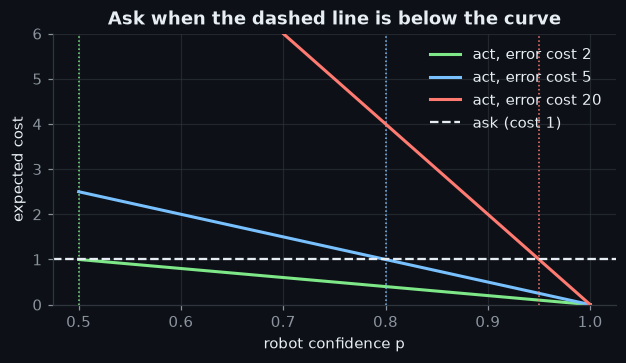
Acting costs error_cost × (1 - p) on average; asking costs ask_cost. The robot asks when the
first is larger. The break-even confidence is 1 - ask_cost / error_cost.
p = np.linspace(0.5, 1.0, 200)
fig, ax = plt.subplots(figsize=(6.6, 3.2))
for err, c in ((2.0, theme['palette'][3]), (5.0, theme['palette'][1]), (20.0, theme['palette'][0])):
    ax.plot(p, err * (1 - p), color=c, lw=2, label='act, error cost %g' % err)
    ax.axvline(1 - 1.0 / err, color=c, ls=':', lw=1)
ax.axhline(1.0, color=theme['text'], ls='--', lw=1.5, label='ask (cost 1)')
ax.set_xlabel('robot confidence p'); ax.set_ylabel('expected cost'); ax.set_ylim(0, 6)
ax.set_title('Ask when the dashed line is below the curve'); ax.legend(loc='upper right')
plt.show()
2. Learn about people, and know when the models disagree#
The robot’s confidence comes from models of how people answer. Early on it has little data, and competing models (quantum-like, Bayesian, anchoring) may predict different things. An ensemble weighs them by evidence and reports how much they disagree; while they disagree, the robot asks regardless of cost. The people here are simulated from a quantum-like population.
rng = np.random.default_rng(3)
people = domain_models('object_clarification')['QL']
counts = {'AB': np.zeros(4, int), 'BA': np.zeros(4, int)}
rows = []
for batch in range(1, 7):
    new = people.sample(None, 25, rng)
    counts = {c: counts[c] + new[c] for c in counts}
    ens = HumanModelEnsemble([QuantumOrderModel4D, BayesOrderModel, AnchoringOrderModel]).update(counts, restarts=4, rng=rng)
    pred, unc = ens.predict('AB')
    p_confirm = pred[0] + pred[1]
    action = ask_or_act(p_confirm, unc, ask_cost=1.0, error_cost=1.5, max_disagreement_bits=0.01)['action']
    rows.append((50 * batch, p_confirm, unc['model_disagreement_bits'], action))
    print('%3d people  P(confirm) %.3f  disagreement %.4f bits  -> %s' % rows[-1])
print('ensemble weights:', [(s['model'], round(s['weight'], 2)) for s in ens.summary()])
50 people P(confirm) 0.443 disagreement 0.0225 bits -> ask
100 people P(confirm) 0.437 disagreement 0.0016 bits -> act
150 people P(confirm) 0.501 disagreement 0.0024 bits -> act
200 people P(confirm) 0.524 disagreement 0.0015 bits -> act
250 people P(confirm) 0.516 disagreement 0.0008 bits -> act
300 people  P(confirm) 0.517  disagreement 0.0010 bits  -> act
ensemble weights: [('BayesOrderModel', 0.77), ('QuantumOrderModel4D', 0.23), ('AnchoringOrderModel', 0.0)]
n, pc, dis, act = zip(*rows)
fig, ax1 = plt.subplots(figsize=(6.8, 3.2))
ax1.plot(n, dis, 'o-', color=theme['palette'][0], label='model disagreement (bits)')
ax1.axhline(0.01, color=theme['palette'][0], ls=':', lw=1)
ax1.set_xlabel('people observed'); ax1.set_ylabel('disagreement (bits)')
ax2 = ax1.twinx(); ax2.grid(False)
ax2.plot(n, pc, 's--', color=theme['palette'][1], label='P(confirm)'); ax2.set_ylabel('P(confirm)')
for x, a in zip(n, act):
    ax1.annotate(a, (x, max(dis) * 1.05), ha='center', color=theme['palette'][3] if a == 'act' else theme['text'])
ax1.set_title('The robot asks until its models agree'); fig.legend(loc='center right')
plt.show()
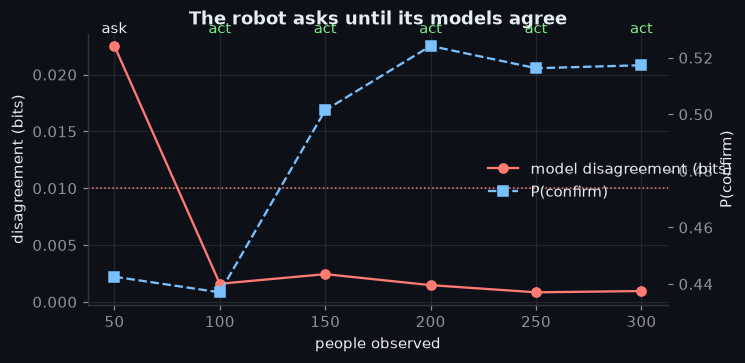
The ensemble gives most weight to the Bayesian model here even though the people are quantum-like: for the question order the robot uses, both predict the same answers, and the Bayesian model has fewer parameters. The models differ only on the reversed order, which is why the order matters when designing what to ask (tutorial 7).
3. Hazard: some mistakes are worse than others#
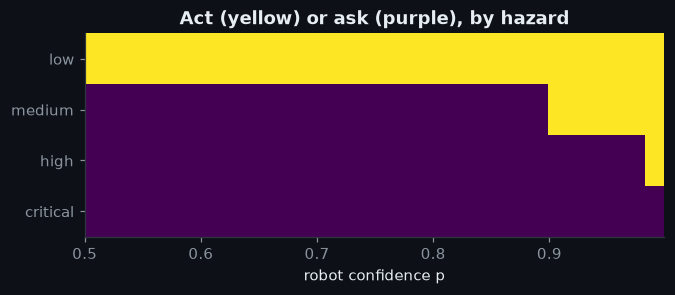
Handing over a cup is low risk; handing over a knife is not. risk_aware_ask_or_act uses a cost per
hazard level and can also use a lower confidence bound (p_lower) instead of the point estimate.
print('hazard costs:', HAZARD_COSTS)
levels = list(HAZARD_COSTS)
grid = np.linspace(0.5, 0.999, 60)
M = np.array([[risk_aware_ask_or_act(pp, h)['action'] == 'act' for pp in grid] for h in levels])
fig, ax = plt.subplots(figsize=(6.8, 2.4))
ax.imshow(M, aspect='auto', cmap='viridis', extent=[grid[0], grid[-1], len(levels) - 0.5, -0.5])
ax.set_yticks(range(len(levels)), levels); ax.set_xlabel('robot confidence p'); ax.grid(False)
ax.set_title('Act (yellow) or ask (purple), by hazard')
plt.show()
hazard costs: {'low': 2.0, 'medium': 10.0, 'high': 100.0, 'critical': 1000.0}
The statements below are checked by this cell every time the documentation is built:
assert rows[0][3] == 'ask' and rows[-1][3] == 'act'     # asks while the models disagree, then acts
assert rows[-1][2] < 0.01
print('checked')
checked
Summary. The decision layer is small and framework-free: call it from a ROS 2 node, a behaviour tree or a planner. What makes it work is reliable inputs: calibrated confidence (tutorial 5) and models that know when they disagree.
References: Howard (1966), IEEE Trans. Systems Science and Cybernetics 2, 22-26; Kochenderfer et al. (2022), Algorithms for Decision Making, MIT Press.