
Question-order effects#
When two questions are asked one after the other, the answers often depend on which came first. In a 1997 Gallup poll, 50% said Bill Clinton was honest when that question came first, but 57% when it came after the same question about Al Gore. This tutorial fits that published data with a quantum-like model and its classical rivals, runs the QQ test (a parameter-free prediction of projective models) and checks whether model comparison can tell the models apart.
import numpy as np
import matplotlib.pyplot as plt
from scipy.optimize import least_squares
from quantum_mind.viz import use_mpl_style
from quantum_mind.data import CLINTON_GORE
from quantum_mind.families.order_effects import (QuantumOrderModel, AnchoringOrderModel, BayesOrderModel,
                                                 RANK_STRUCTURES, rates, qq_test)
theme = use_mpl_style('dark')
r = CLINTON_GORE['rates']
observed = np.array([r['A_first'], r['B_first'], r['A_second'], r['B_second']])
print('Observed "yes" rates (Moore 2002): A first, B first, A second, B second =', observed)
Observed "yes" rates (Moore 2002): A first, B first, A second, B second = [0.5 0.68 0.57 0.6 ]
1. Fit three models to the four rates#
The quantum-like model puts the belief and the two “yes” subspaces in a three-dimensional space, with three angles. The anchoring model is the classical alternative that allows order effects: the second answer is pulled towards the first. The Bayesian model gives each question a fixed probability, so it cannot produce an order effect at all.
best = None
for st in RANK_STRUCTURES:
    for seed in range(20):
        fit = least_squares(lambda x: rates(QuantumOrderModel(a=x[0], b=x[1], g=x[2], **st).predict()) - observed,
                            np.random.default_rng(seed).uniform(0, np.pi, 3))
        if best is None or fit.cost < best[0].cost:
            best = (fit, st)
ql = QuantumOrderModel(a=best[0].x[0], b=best[0].x[1], g=best[0].x[2], **best[1])
y = least_squares(lambda y: rates(AnchoringOrderModel(pA=y[0], pB=y[1], wA=y[2], wB=y[3]).predict()) - observed,
                  [0.5, 0.6, 0.2, 0.2], bounds=([0.01, 0.01, -0.99, -0.99], [0.99, 0.99, 0.99, 0.99])).x
anc = AnchoringOrderModel(pA=y[0], pB=y[1], wA=y[2], wB=y[3])
bay = BayesOrderModel(pA=observed[[0, 2]].mean(), pB=observed[[1, 3]].mean(), rho=0.0)
fits = {'quantum-like': rates(ql.predict()), 'anchoring': rates(anc.predict()), 'Bayes': rates(bay.predict())}
for k, v in fits.items():
    print('%-13s %s' % (k, v.round(3)))
quantum-like  [0.498 0.678 0.572 0.602]
anchoring     [0.5  0.68 0.57 0.6 ]
Bayes         [0.535 0.64  0.535 0.64 ]
labels = ['Clinton\nfirst', 'Gore\nfirst', 'Clinton\nsecond', 'Gore\nsecond']
x = np.arange(4)
fig, ax = plt.subplots(figsize=(7.2, 3.4))
ax.bar(x - 0.3, observed, 0.2, label='observed', color=theme['text'], alpha=0.85)
for i, (k, v) in enumerate(fits.items()):
    ax.bar(x - 0.1 + 0.2 * i, v, 0.2, label=k, color=theme['palette'][i])
ax.set_xticks(x, labels); ax.set_ylim(0.4, 0.75); ax.set_ylabel('P("yes, honest")')
ax.set_title('Clinton-Gore question order: data and fits'); ax.legend(ncol=4, loc='upper left')
plt.show()
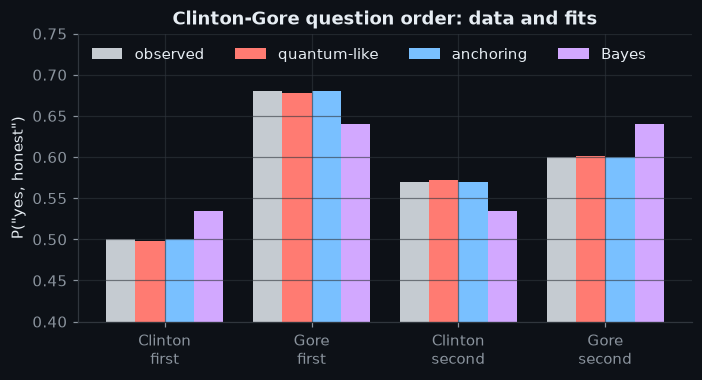
The Bayesian model gives the same rate in both positions, so it misses the shift. Both order models reproduce it with their parameters.
2. The QQ test#
Projective models predict, with no free parameters, that the probability of answering the two questions the same way (yes-yes or no-no) is the same in both orders: \(q = [p_{AB}(yy) + p_{AB}(nn)] - [p_{BA}(yy) + p_{BA}(nn)] = 0\). The anchoring model has no such constraint. The published study only reports the four rates, so here the joint counts are simulated from each fitted model (1000 people per order) to show what the test detects.
for name, model in (('quantum-like', ql), ('anchoring', anc)):
    counts = model.sample(None, 1000, np.random.default_rng(7))
    q, z, p = qq_test(counts)
    print('%-13s data: q = %+.3f, z = %+.2f, p = %.3f' % (name, q, z, p))
quantum-like  data: q = -0.008, z = -0.55, p = 0.579
anchoring     data: q = -0.049, z = -2.40, p = 0.016
3. Can the models be told apart?#
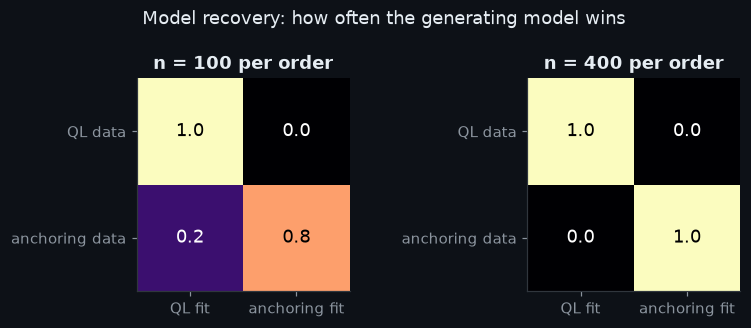
Model recovery: simulate data from each model, fit both, and count how often the generating model wins by BIC (10 simulated studies per cell here; use more for a real design). If recovery is poor at a given sample size, a study of that size cannot settle the question.
from quantum_mind.core import recovery
gens = {'quantum-like': ql, 'anchoring': anc}
out = {}
for n in (100, 400):
    rec = recovery(gens, [(QuantumOrderModel, {'structures': RANK_STRUCTURES}), AnchoringOrderModel],
                   None, n, reps=10, rng=np.random.default_rng(0), restarts=4)
    out[n] = rec
    print('n = %d per order:' % n, rec)
n = 100 per order: {'quantum-like': {'QuantumOrderModel': 10, 'AnchoringOrderModel': 0}, 'anchoring': {'QuantumOrderModel': 2, 'AnchoringOrderModel': 8}}
n = 400 per order: {'quantum-like': {'QuantumOrderModel': 10, 'AnchoringOrderModel': 0}, 'anchoring': {'QuantumOrderModel': 0, 'AnchoringOrderModel': 10}}
fig, axes = plt.subplots(1, 2, figsize=(7.4, 3.0))
for ax, (n, rec) in zip(axes, out.items()):
    M = np.array([[rec[g].get(c, 0) for c in ('QuantumOrderModel', 'AnchoringOrderModel')] for g in gens]) / 10
    ax.imshow(M, vmin=0, vmax=1, cmap='magma')
    for i in range(2):
        for j in range(2):
            ax.text(j, i, '%.1f' % M[i, j], ha='center', va='center', color='white' if M[i, j] < 0.6 else 'black', fontsize=12)
    ax.set_xticks([0, 1], ['QL fit', 'anchoring fit']); ax.set_yticks([0, 1], ['QL data', 'anchoring data'])
    ax.set_title('n = %d per order' % n); ax.grid(False)
fig.suptitle('Model recovery: how often the generating model wins'); plt.tight_layout(); plt.show()
The statements below are checked by this cell every time the documentation is built:
err = {k: np.abs(v - observed).max() for k, v in fits.items()}
assert err['Bayes'] > 0.03 and err['quantum-like'] < 0.01 and err['anchoring'] < 0.01   # Bayes misses the shift
p_ql = qq_test(ql.sample(None, 1000, np.random.default_rng(7)))[2]
p_an = qq_test(anc.sample(None, 1000, np.random.default_rng(7)))[2]
assert p_ql > 0.05 > p_an                        # the QQ test separates the two order models
assert out[400]['quantum-like']['QuantumOrderModel'] >= 8 and out[400]['anchoring']['AnchoringOrderModel'] >= 8
print('checked')
checked
Summary. The order effect itself rules out the Bayesian model. Separating the quantum-like model from anchoring needs the joint answers (the QQ test) and enough people per order; recovery shows how many.
References: Moore (2002), Public Opinion Quarterly 66, 80-91; Wang & Busemeyer (2013), Topics in Cognitive Science 5, 689-710; Wang et al. (2014), PNAS 111, 9431-9436.