
COBRA belief filter (quantum_mind.belief)#
A robot watching a person receives a stream of sensor frames. What a reading means often depends on what came just before it: the same hand movement signals a hand-over after a look at the robot and a retrieval after a look away. A classical Bayes filter treats the frames as conditionally independent and cannot represent that. COBRA keeps the belief as a density matrix and lets the previous frame rotate the basis in which the next frame is measured. The equations are on the mathematics page.
Object |
What it does |
|---|---|
|
Trainable context-rotated density-matrix belief filter; |
|
The same filter one frame at a time: |
|
The commutative classical reference |
|
Action with the lowest expected cost; give it an “ask” row to let the robot hedge |
import numpy as np
from quantum_mind.belief import COBRA, GaussianBayesFilter, min_cost_action

model = COBRA(n_hyp=3, n_features=3).fit(frames, intent)    # frames (N, T, 3), intent in {0, 1, 2}
belief = model.start()                                       # online, as on a robot
for frame in sensor_stream:
    p = belief.update(frame)                                 # P(handover, retrieve, withdraw)

cost = np.array([[0, 6, 10], [1.5, 0, 0], [0.8, 0.8, 0.8]])  # hand over, wait, ask
action = min_cost_action(p, cost)[0]
Two classical limits, built in#
With H = 0 (no rotation) COBRA is a Bayes filter; with full dephasing (g = 1) it is a classical
context-dependent filter with no phase between frames. Comparing the three isolates what the context
rotation and the coherence each add. The test suite checks both limits exactly
(tests/test_math_docs.py).
Figures#
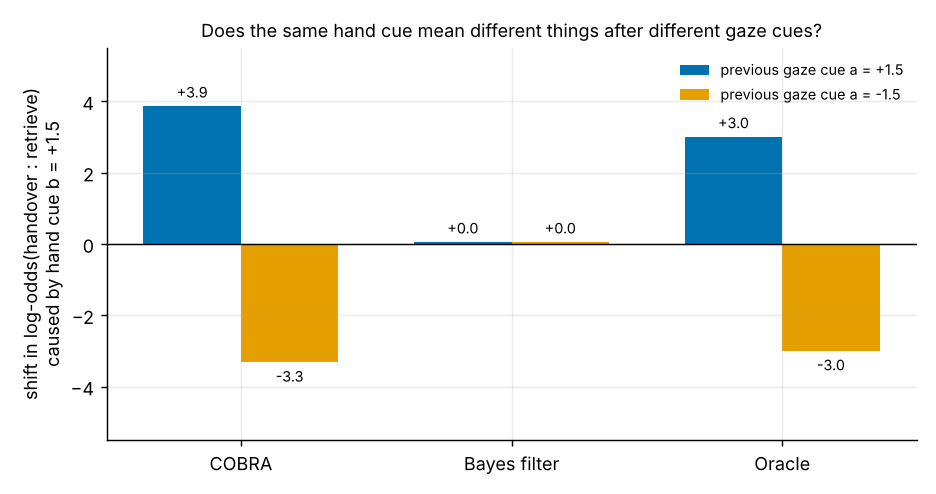
What it learned: context-dependent meaning of a cue. The shift in log-odds(handover : retrieve) that one hand cue adds after opposite previous looks. A Bayes filter adds the same amount either way; the oracle flips sign, and so does this trained COBRA (one model, seed 0).
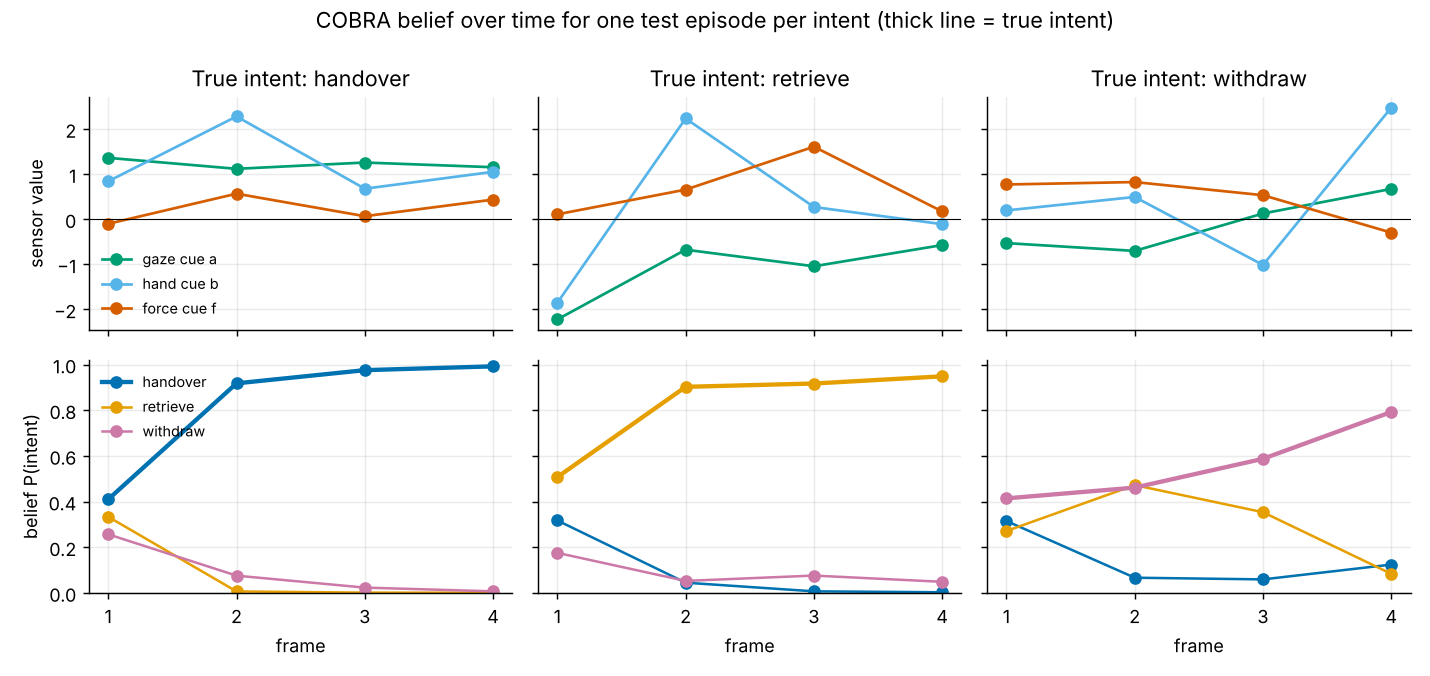
Belief over time for one correctly classified episode per intent:
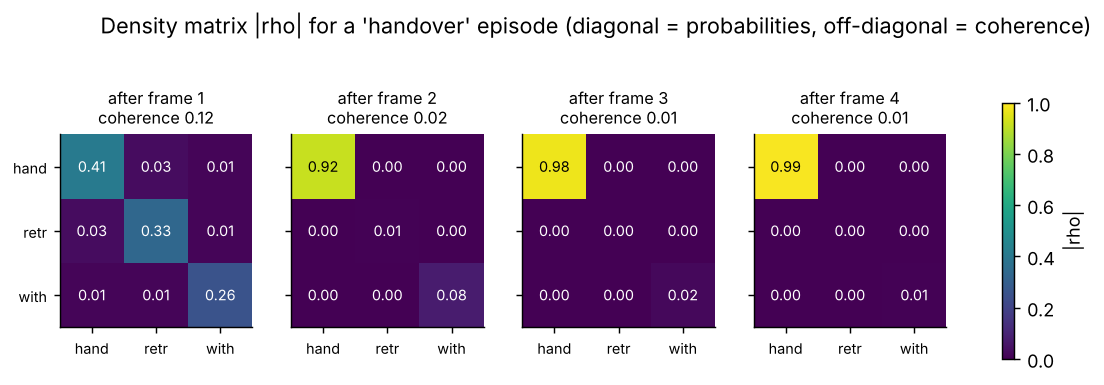
The density matrix |rho| after each frame. The coherences are small (about 0.1 after the first frame, about
0.01 afterwards), so most of the work is done by the context-rotated evidence step.
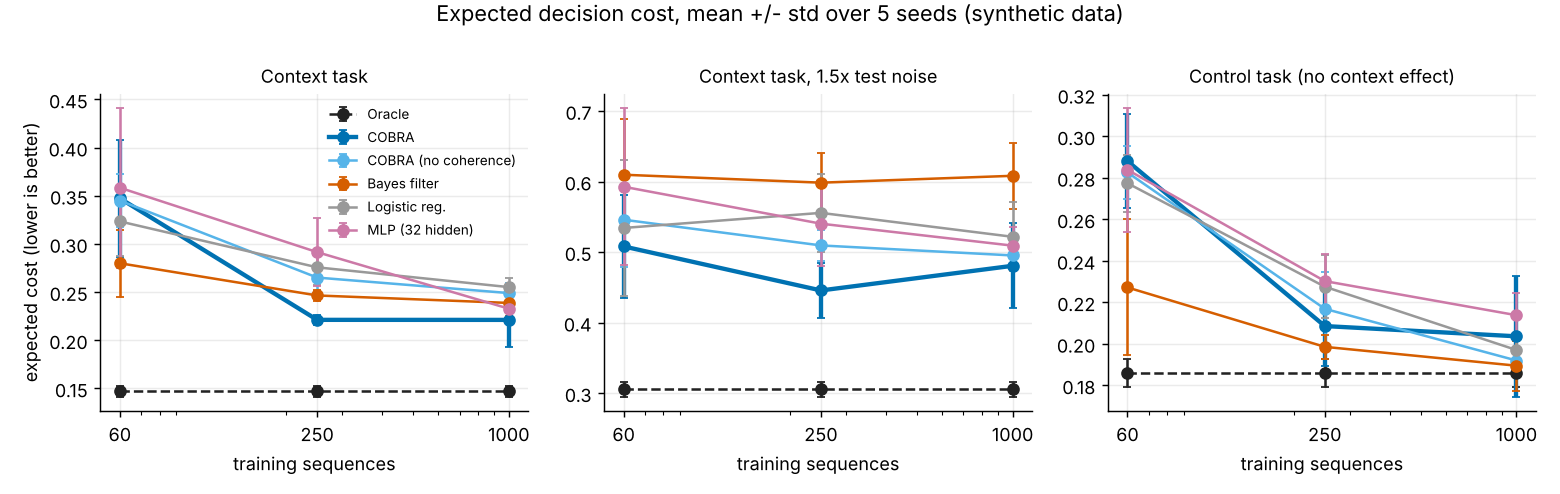
Benchmark. Expected decision cost against training size (mean and std over 5 seeds):
What is and is not claimed#
It is a classical simulation of the quantum-probability formalism and runs on NumPy. No quantum computational advantage is claimed.
On a synthetic intent task built to contain a context effect, it lowers the expected decision cost by about 0.02 against the Bayes filter with 250 to 1000 training sequences (a paired test is significant in only 2 of 5 seeds) and is the best calibrated model under 1.5x test noise. With 60 training sequences it is worse (+0.07), on a control task with no context effect it is slightly worse than the Bayes filter (+0.01), and training sometimes misses the context mechanism (see
benchmarks/context_intent_benchmark.pyand itsresults/).The coherence of the belief is a weak error flag; belief entropy is far better.
No study with real people or a real robot has been run.